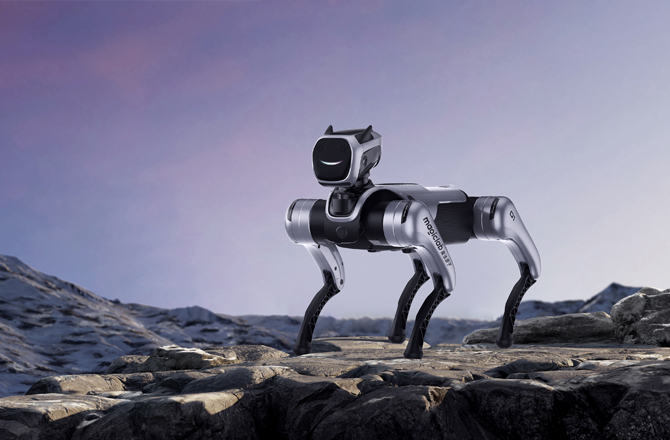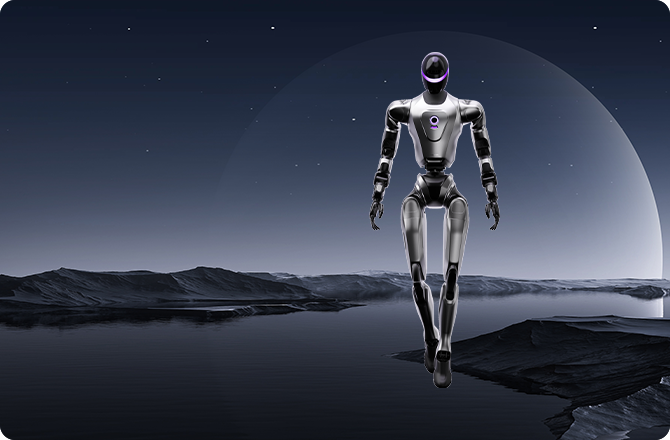

At the 2026 CCTV Spring Festival Gala, Magiclab completed a high-density technology debut as the only robotics company on the Gala stage whose robots could both “perform” and “do real work.”
At the main venue, six Magiclab humanoid robots, MagicBot Z1, and two MagicBot Gen1 robots performed Intelligent Manufacturing for the Future alongside artists including Jackson Yee and Jerry Yan. At the Yibin sub-venue, more than 100 quadruped robots, MagicDog, appeared in a large-scale swarm performance dressed as “giant pandas.”
At the same time, Magiclab brought a real scenario of multi-humanoid robot collaboration to the Spring Festival Gala stage for the first time, allowing audiences around the world to intuitively experience robots entering real life.
“This year, what Magiclab brought to the Spring Festival Gala was not just a performance, but a full-dimensional ‘technical review,’” said Gu Shitao, co-founder of Magiclab. “We want the public to see that robots can not only sing and dance, but also become truly intelligent and capable partners. We also want the world to see that the ‘Chinese intelligent manufacturing’ represented by Magiclab is accelerating onto the international stage through a dual strategy of commercialization and globalization.”
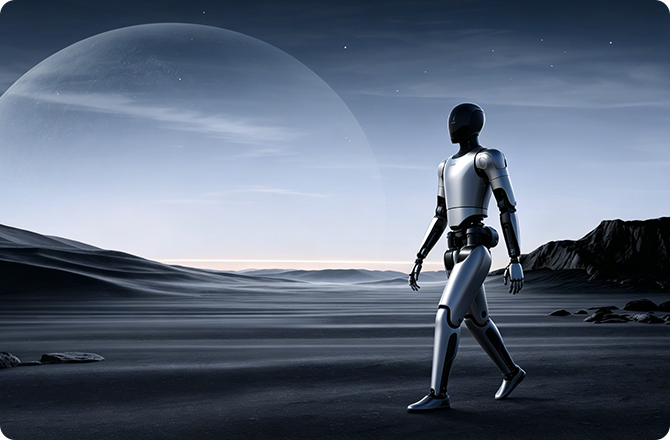
In the main venue program Intelligent Manufacturing for the Future, beams of technology-inspired light created a highly futuristic stage space. As the music progressed, six high-dynamic bipedal humanoid robots, MagicBot Z1, and two full-size general-purpose humanoid robots, MagicBot Gen1, appeared on stage, performing together with Jackson Yee, Jordan Chan, Jerry Yan, and Luo Jiahao.
During the performance, the robots achieved a high degree of alignment between motion trajectories and musical rhythm. Rapid turns, dynamic transitions, and continuous choreographed movements were completed with stability, maintaining overall consistency and near-zero-error execution. Whether in center-of-gravity transfer, balance adjustment, or multi-joint coordinated control, Z1 delivered stable output, demonstrating the engineering maturity of its whole-body motion control and real-time coordination algorithms.
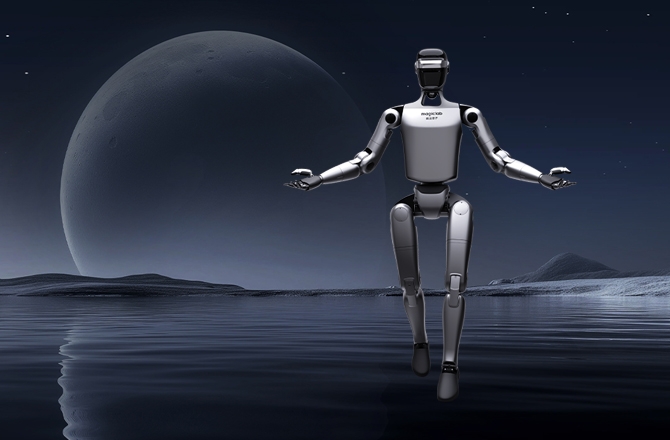
In addition to the main-stage song and dance performance, Z1 also demonstrated a series of highly challenging movements at the sub-venue, including Thomas-style moves and 360-degree “moon kick” stunts. Taking the “Thomas stunt” as an example, the robot completed takeoff and landing control while supported on a single point, performing continuous rotations and posture transitions. This places extremely high demands on whole-body coordination, center-of-gravity management, and instantaneous power distribution, making it one of the highest-level public validations of bipedal robot capability.
The stable presentation of these movements on the Spring Festival Gala stage was not the result of last-minute tuning. Since the release of Z1 in July 2025, the robot has undergone nearly six months of validation and iteration. Its structural strength, peak torque of joint modules, and response speed have been continuously optimized, enabling physical redundancy and structural safety margins for high-speed jumps and continuous rotations.
On the software side, the team built a data collection system and dynamic training framework covering real-world scenarios. Based on imitation learning control solutions, the system enables real-time optimization of momentum management and center-of-gravity transfer. The robot’s stable performance during single-point support and continuous posture transitions essentially comes from the deep coupling between system-level control strategies and hardware performance.
The appearance of MagicBot Z1 was not merely a visual showcase, but a public test of the robot’s capability boundaries and engineering maturity.
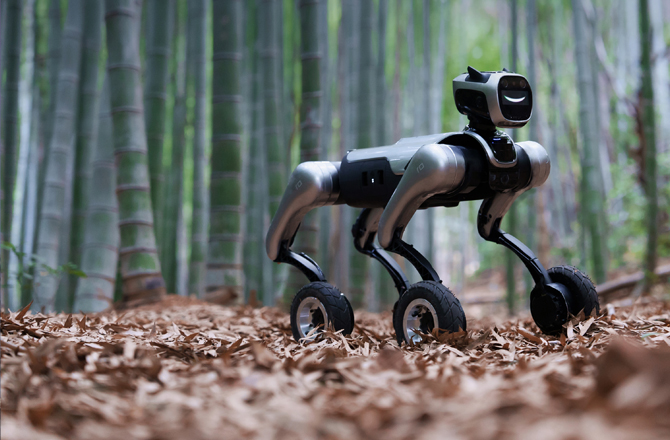
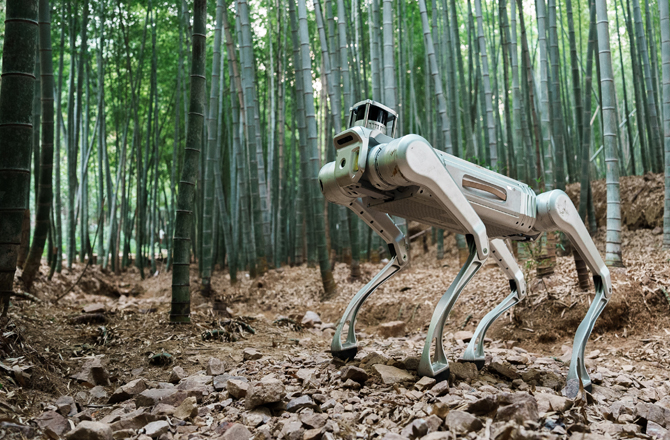
At the Yibin sub-venue, more than 100 Magiclab quadruped robots appeared as “special-form performers” in the image of giant pandas. On camera, the robotic pandas surged forward, danced, tilted their heads, and waved their paws. Their lifelike panda appearance and agile movement vividly captured the adorable and relaxed nature of giant pandas, creating a highly coordinated “swarm intelligence” effect and becoming one of the most eye-catching technology scenes at the Spring Festival Gala sub-venue.
On a live broadcast stage of this highest level, every detail is magnified and tested. The robots not only needed to look realistic as giant pandas, but also had to maintain motion accuracy and group coordination during dynamic performance. This required a closed loop among “form expression, motion control, and swarm scheduling,” placing higher demands on Magiclab’s design aesthetics, engineering capabilities, and system integration strength.
The first challenge was appearance adaptation. Due to the added weight of the panda head covering, the center-of-gravity distribution and motion inertia of the robot dog changed. This meant that the team had to recalibrate the robot’s overall dynamics model and motion control parameters.
In close-up shots, the robotic pandas could be seen making natural head-tilting movements. To achieve this effect, Magiclab introduced a three-degree-of-freedom head-drive solution on the robot dog body, enabling mechanical coupling among the robot body, panda exterior covering, and motor modules. At the same time, the control system was reconstructed so that the robotic panda’s head movement could coordinate with gait and formation rhythm.
Beyond appearance, sustained high-load operation was another critical challenge. Continuous running and dancing placed constant pressure on the drive system. The external covering further compressed the heat dissipation space, increasing instantaneous power demand and exposing the joint modules to risks of overheating and protection-triggered shutdown. Through optimized current management and power control strategies, the team enabled the drive system to maintain stable output under continuous high-load operation, ensuring the coherence of the entire performance.
Meanwhile, more than 100 robots had to receive high-frequency control commands within the same time window. To prevent accumulated latency or local frame drops, Magiclab decomposed the overall movements into standardized poses and time sequences, issued them through unified encoding, and executed them through single-robot decoding, achieving millisecond-level synchronization in a high-density scheduling scenario.
The collective performance of more than 100 “robotic pandas” was not only a concrete display of swarm intelligence, but also a concentrated test of product consistency, control architecture, and engineering reliability.
At the 501 liquor culture landmark in the Yibin sub-venue, Magiclab brought “robots that can do real work” into the view of Chinese audiences worldwide. This also marked a first for the Spring Festival Gala stage: robots were no longer limited to entertainment-style presentation, but began to take on execution roles in specific real-world scenarios.
In a lively street scene, MagicBot Gen1 transformed into a “noodle chef,” completing a series of continuous operations such as lifting noodles, draining water, and pouring noodles, while also pouring liquor for an elderly guest. MagicBot Z1 appeared as a “food delivery worker,” steadily delivering Yibin burning noodles to the table. One robot handled fine manipulation, while the other completed the service loop. Multi-form humanoid robots collaborated in the same real scenario, breaking down a series of lifelike everyday actions into executable capability demonstrations.
Gen1 relied on its dexterous hands to achieve fine grasping and force control, while Z1 handled the “last-mile” mobile execution. Behind this division of labor and collaboration was the team’s integrated operation of scene understanding, task planning, and motion control systems. The cognitive layer was responsible for understanding the environment and decomposing tasks, while the control layer ensured precise execution, allowing the “brain” and “cerebellum” to form a closed loop within the same architecture.
To support this capability, the team modeled action trajectories based on human operation data, then carried out reinforcement training and stability iteration in simulation environments, bringing grasping accuracy, force control, and motion rhythm into a controllable range. After simulation validation, the control strategies were transferred to physical robots for execution. Based on accumulated experience across multiple scenarios, the robots achieved stable adaptation to real-world environmental changes and cross-scenario transfer.
The significance of completing real service actions by humanoid robots in such a high-profile public setting as the Spring Festival Gala goes beyond program innovation. When robots begin to undertake concrete tasks rather than simply complete stage choreography, the industry’s evaluation criteria are shifting—from demonstration capability to engineering maturity and scenario execution capability.
From single-robot extreme motion, to hundred-robot swarm coordination, and then to a closed loop of real-world service scenarios, Magiclab demonstrated a complete capability pathway at this year’s Spring Festival Gala. This was not merely a public appearance; it marked embodied intelligence moving from the “demonstration stage” into the “implementation stage.”

 English