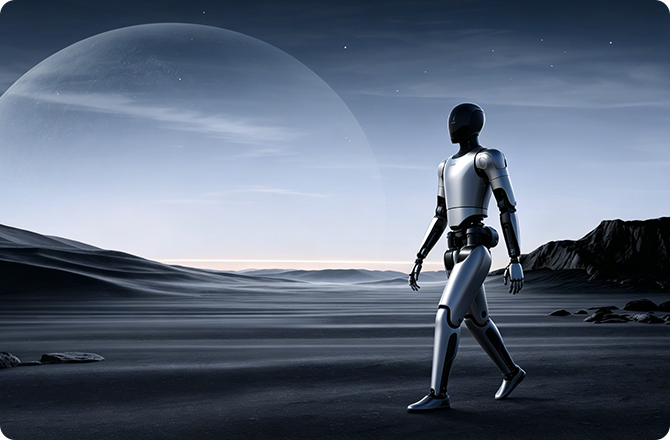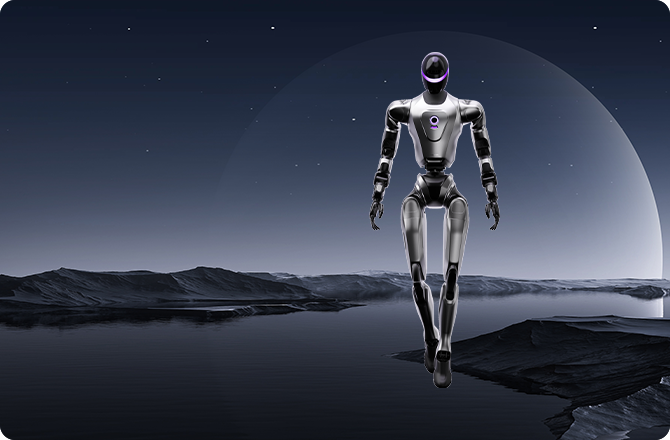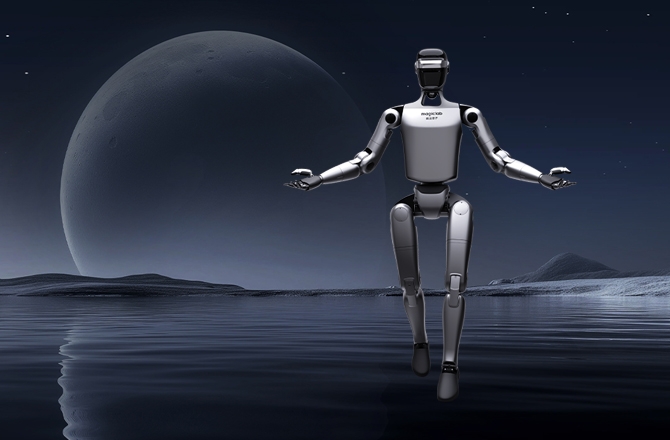

Humanoid robotics represent the ultimate expression of mechanical design, engineered to operate seamlessly in spaces built entirely for human workers. Drawing inspiration from agile bipedal developments and commercial service platforms driven by industry leaders like Figure AI and Pudu Robotics, Magiclab Robotics has engineered the MagicBot series to break past traditional physical limits. Combining aerospace-grade materials with advanced reinforcement learning, our humanoids deliver unprecedented operational flexibility.
To match human dexterity and movement range, a humanoid robot requires exceptional mechanical engineering. MagicBot systems feature ultra-wide joint rotation capabilities—up to 320° in select joints—driven by high-torque proprietary actuators that deliver robust peak joint forces. This allows the robots to perform dynamic maneuvers, maintain stability under heavy loads, and execute fluid, human-like locomotion across diverse indoor and outdoor terrains.
Mobility alone is insufficient without fine motor skills. Magiclab equips its humanoid platforms with highly articulated, self-developed dexterous hands powered by tactile sensing and computer vision. This enables the robots to perform complex tasks previously reserved for human hands, ranging from delicate laboratory sample handling and retail shelf restocking to precise assembly work and intricate food preparation, such as coffee latte art.
Traditional robot programming relies on painstaking, manual line-by-line coding for every new task. Magiclab bypasses this bottleneck by integrating imitation learning (IL) and reinforcement learning (RL) frameworks. This allows humanoids to master complex full-body movements and tool usage rapidly—often within a 24-hour training window—significantly reducing deployment times and operational overhead for enterprise adopters.
Industrial environments demand extreme durability. Magiclab humanoids are constructed using advanced lightweight composite materials, including titanium alloys and aerospace-grade magnesium-aluminum alloys. These sturdy chassis designs are paired with hot-swappable battery systems to ensure minimal downtime, supporting continuous, round-the-clock shift rotations in demanding logistics and manufacturing facilities.
The future of automation is inherently humanoid, requiring a balance of raw mechanical strength and adaptive intelligence. Through continuous refinement in joint design, dexterous manipulation, and rapid machine learning, MagicBot humanoids provide a truly versatile labor force for the modern enterprise.
Unlike fixed industrial robot arms, MagicBots possess bipedal mobility and human-like form factors, allowing them to operate inside standard human-centric environments without facility redesign.
Utilizing advanced imitation and reinforcement learning algorithms, MagicBot systems can adapt to and master new movement or handling workflows within a 24-hour training cycle.
They utilize aerospace-grade composite materials, including titanium alloys and magnesium-aluminum alloys, ensuring high structural integrity with minimal weight.
Yes, equipped with high-precision tactile sensors and self-developed dexterous hands, they achieve high-accuracy pick-and-place operations suitable for fragile items.
Yes, they offer open API and SDK access, making them ideal development platforms for universities and research labs focusing on embodied AI.
Figure AI - Humanoid Research & Development: https://www.figure.ai/
Unitree Robotics - Humanoid and Legged Systems: https://www.unitree.com/
Pudu Robotics - Intelligent Service Innovations: https://www.pudurobotics.com/en
Magiclab Global Official Platform: https://www.magiclabglobal.com/

 English